

Why Your Teeth Replacement Treatment Choices Decide What’s for Dinner
May 1, 2026
Ever wonder why some folks with dentures stick to soup while others that you know had full mouth tooth replacements bite into a juicy steak without flinching? It comes down to functional capacity, which is just a fancy way of saying how much chewing power your prosthesis actually gives you back.
When teeth go missing in the lower and upper jaw, the options aren’t all created equal. The mandible (your lower jaw) is the moving piece in the chewing equation, and what you replace those teeth with directly shapes the menu you can handle. Here’s how the major treatments stack up, starting with the least supportive and working toward something that feels close to the real thing.
Starting Point: No Teeth, Big Limits
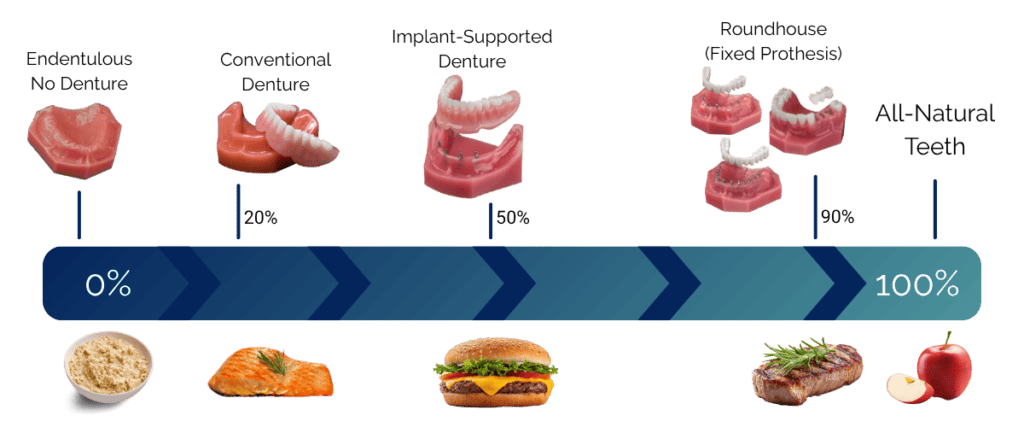
A bare jaw with no replacement sits at roughly 0% functional capacity. Applesauce, broth, mashed potatoes, that’s about it. Bite force in this state is essentially gum pressure, and anything that needs real grinding becomes a problem. It’s not just the food, either. Speech changes, the ability to digest food decreases, the jaw begins to lose bone, and the lower third of the face starts to look shorter over time. Confidence usually takes the biggest hit, honestly.
Conventional Dentures: A Step Up, but Not by Much
A traditional denture rests on the gum tissue and stays put through suction and a little help from denture adhesive. That suction works pretty well on the upper jaw. On the bottom? Not so much. The denture has less surface area to grip onto and has to compete with the tongue, so movement during meals is common.
Bite force lands somewhere around 20% capacity or 50 pounds per square inch on a good day, compared to 200 to 250 psi for natural teeth (a range cited in Journal of Prosthetic Dentistry research). Patients wearing conventional dentures usually settle into softer foods: flaky fish, eggs, well-cooked pasta, tender vegetables.
Implant-Supported Dentures: Where Things Get Interesting
Now we’re talking. Add two to four implants in the jaw, snap a denture onto them, and you’ve got something that won’t slide around when you laugh or chew. A 5-year clinical study published in Dentistry Journal found mini dental implants used to retain mandibular overdentures had a 100% success and survival rate, with patients showing measurable increases in bite force over time.
Functional capacity climbs into the 50 to 60% range here. Sandwiches, grilled chicken, most fruits and vegetables come back into play. The denture is still removable for cleaning, which some patients actually prefer.
The Roundhouse: As Close to Natural as It Gets
A Roundhouse (sometimes called an All-on-X) uses more implants than an Implant-Supported Denture to anchor a permanent zirconia bridge. It’s cemented in place and stays there. You brush it, waterpik around it, and get it cleaned at your regular checkups, just like real teeth.
Bite force returns to roughly 90% of natural function, sometimes higher. Full-arch implant restorations consistently restore the highest functional capacity of any tooth-replacement option, according to research summarized by the American College of Prosthodontists. Steaks, raw vegetables, crunchy apples, corn on the cob, all back on the menu.
So What’s the Right Pick?
Here’s the thing. The answer depends on bone density, budget, lifestyle, and which foods actually matter to you. Someone perfectly happy with soft foods and a removable appliance might love an overdenture. A patient who refuses to give up their grandmother’s brisket recipe might be a Roundhouse candidate from day one.
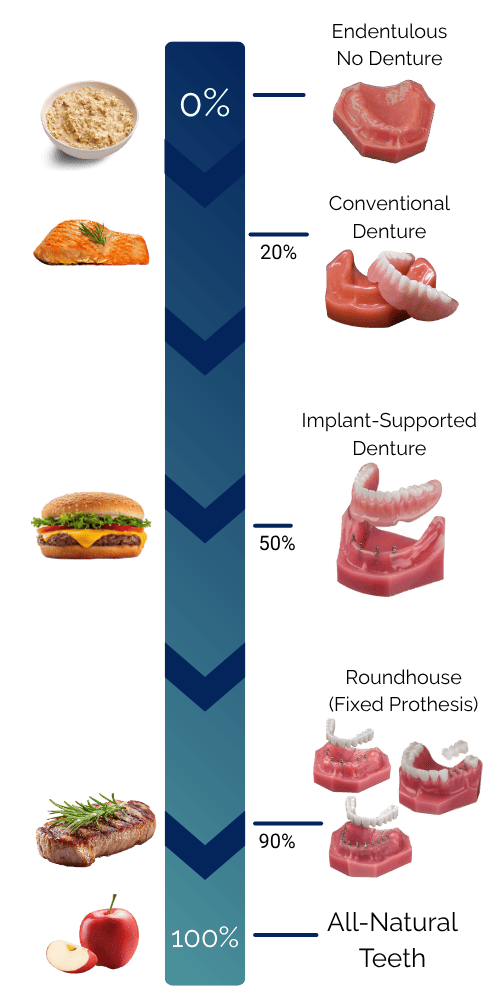
The chart at the top of this post lays it out visually. Each step up the ladder buys you back more of the foods you grew up loving. If you’re in the Hagerstown area and curious where you’d land, the team at Potomac Dental Centre runs CT scans, walks through pricing, and helps you figure out which treatment matches your jaw, your goals, and your dinner plans.
Ready to see if you’re a candidate? The quick eligibility quiz on our dental implants page takes about two minutes and gives you a starting point for the conversation.